Case Landing: Furniture That Gives Guest Luggage Somewhere to Go
Photo: John Salmon, CC BY-SA 2.0, via Wikimedia Commons
Arrival day in a lodge has a rhythm. The car doors go, the dog jumps out, someone says they need the loo, and then the cases come in. Two wheelies, a holdall, a cool bag, a bag of wellies, and a wet coat that never quite made it onto a hook. Within four minutes the hallway is a slalom course and the front door won't open fully. It isn't a cleaning problem. It's a furniture problem.
Most lodge bedrooms give a case exactly one place to land: the floor. So it sits there, open, half-unpacked, for the whole stay, and everyone steps around it. The fix isn't a luggage rack in every corner or a hotel-style valet stand. It's a bit of thinking about the arrival route, and a few pieces that quietly do two jobs at once. Here's how to give every case a home without making the place feel like a chain hotel.
Walk the route before you buy anything
Before you buy a bench or a rack, spend five minutes doing something most owners never do: follow the journey from the front door to the bed with a suitcase in your hand. Note the pinch points. A hallway that's 90cm wide is fine for one person and one case, but not for two people passing. A stair turn that looks generous in an empty lodge gets very tight with a 75cm case. And a bedroom door that swings inwards can eat the only clear wall you had.
If the route is awkward, the answer is usually a drop zone at the door rather than more storage in the bedroom. Guests don't want to drag a wet case across a cream carpet to a rack in the far corner. They want to put it down, take their coat off, and have a cup of tea. Plan for that moment first.
The bed-end bench earns its keep
A bench at the foot of the bed is the single most useful luggage piece in a lodge, because it does three jobs: somewhere to sit, somewhere to open a case, and somewhere to drop a folded throw so the room still looks styled. Aim for a depth of 40–50cm and a height of around 45cm, roughly level with the mattress top. Length matters too; 1.2m is the minimum for a double, and 1.4m is better if the room can take it.
A few specs worth caring about. Solid frames beat spindly legs, because lodge floors are rarely perfectly level and thin legs wobble. Wipe-clean upholstery or painted hardwood beats pale linen, especially from October onwards. And a low shelf underneath is a bonus for boots or a folded blanket, but not for cases, because guests won't bend down to fetch them.
Slim racks are better than their reputation
Folding luggage racks get a bad press because people picture hotel conference centres. But a slim rack, 60–70cm wide and 40cm deep, tucked into a wardrobe alcove or beside a bedside table, is genuinely useful for a two-night stay. Look for one with a raised lip so a case doesn't slide off, and check the weight limit; 20–25kg is normal, which covers a checked bag but not a very full family case.
Wall-mounted folding racks are the smarter option for small rooms. They fold flat when not in use, they keep the floor clear, and they signal to guests that someone thought about their arrival. Fit them at about 60cm from the floor so a case can be lifted on without a struggle.
Hall ottomans and the drop zone
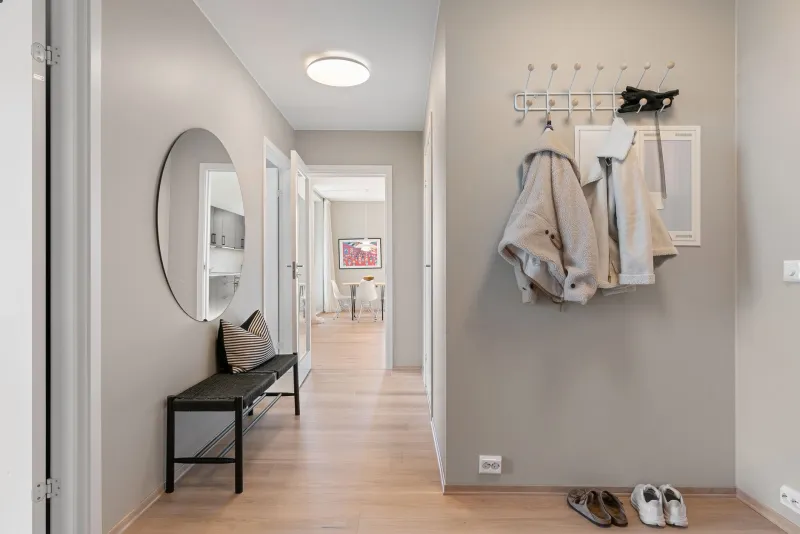
Not every case needs to go to the bedroom immediately. A slim hall bench, 35cm deep with a lift-up lid, gives the arrival moment somewhere to happen. Hats, gloves, dog leads, and the bag of snacks all go inside, and the cases sit on top for the ten minutes it takes to sort out who's sleeping where. Add a hook at around 1.7m for tote bags and a shallow tray for keys, and the hallway stops being a pile.
One caution: a hall ottoman is not long-term luggage storage. It's a landing pad. If guests leave cases there all week, you'll be squeezing past them every changeover, and that's when scuff marks appear on the paintwork.
Under-bed works, but only for the owner
Under-bed space is tempting, and it can be useful, but it's rarely the right home for guest luggage during a stay. Guests need to get at their things, and nobody wants to haul a case out from under a bed every morning. Use the space for spare linen, extra pillows or a folded duvet in a lidded box, and leave guest cases at waist height where they belong. If you do use it, check the clearance first; anything under 25cm will only take shallow boxes.
Materials that cope with wheels and wet
Lodge luggage furniture takes a beating. Cases have hard plastic wheels, wet straps and gritty bases, and they arrive in November as often as July. Avoid suede, pale bouclé and anything that stains at the sight of a damp holdall. Painted hardwood, powder-coated metal and wipe-clean upholstery are the sensible choices. Felt pads on the legs protect wooden floors, and a washable runner underneath the bench saves the carpet from wheel marks.
Handled, not hidden
The difference between a hotel and a well-run lodge is simple. A hotel gives you a rack and a laminated notice. A lodge gives you a bench with a cushion on it, a hook by the door and a tray for keys, and it feels like someone expected you. Don't hide the luggage; make it look handled. A bench with a folded throw and a small lamp above it reads as part of the room, not a utility item.
The quick measuring list
- Clear floor width along the arrival route: 90cm is comfortable, 75cm is workable, anything less needs a rethink.
- Case sizes: a cabin bag is roughly 55 x 40 x 20cm, a large checked case around 75 x 50 x 30cm. A 75cm case needs an 80cm landing spot.
- Bench depth: 40–50cm, leaving at least 60cm of walkway in front of it.
- Rack height: 60cm from the floor for wall-mounted folding racks.
- Door swings: check every bedroom door before you place a bench behind it.
If you're not sure where the problem is, do the quiet-season test. At the next changeover, look for carpet dents, scuffed skirting boards and the spot where the paint has worn thin. That's where guests have been putting their cases. Put a piece of furniture there, and next season the hallway will be clear before the kettle's boiled.